
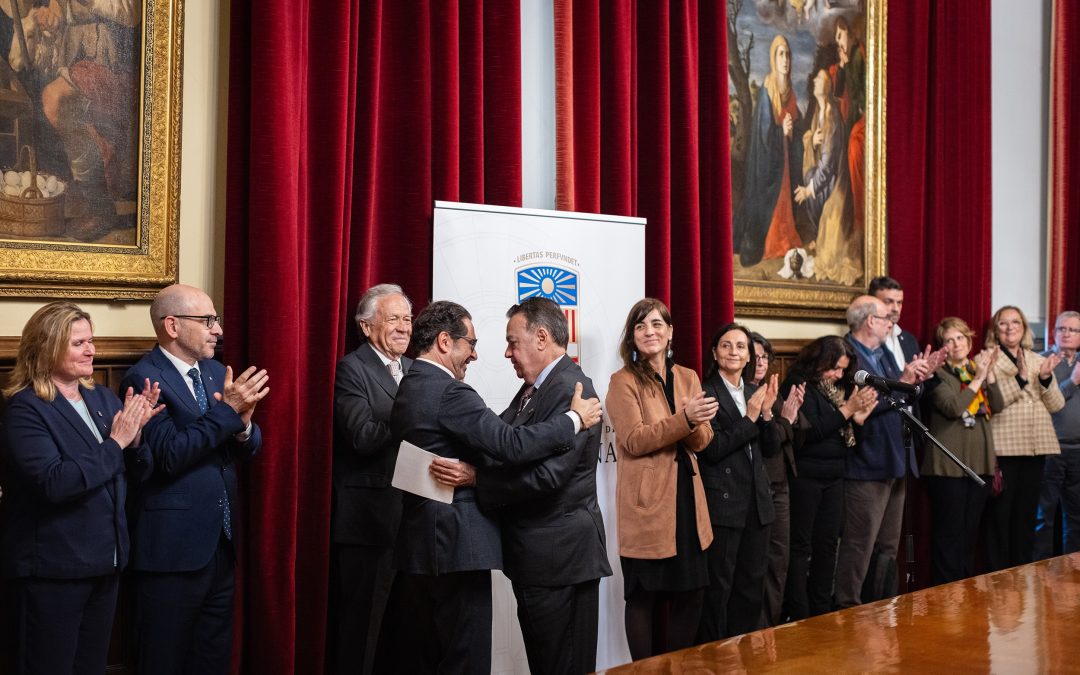
Libertas perfundet omnia luce: “Liberty fills everything with light”. This motto is a declaration of the University of Barcelona’s (UB) principles and the university’s role in society. A few weeks ago, I had the honour of taking up the Chair of the UB Social Council. At the inauguration ceremony, which was attended by Núria Montserrat, the Catalan Government’s Minister for Research and Universities, and Joan Guàrdia, the Vice-Chancellor, I emphasised this point: the university is not merely a place for the transmission of knowledge; it is also a beacon of critical thinking, innovation, and social cohesion.
The University cannot live in isolation, which is precisely why the Social Council exists: to ensure that it is fully connected with the society it serves.
Throughout my professional life, I have learned that talent is the ability to keep learning. It is not how much we know that makes the difference, but how much we are willing to learn. Digitalisation, AI, the energy transition and new industrial models are transforming our world at an enormous pace.
This rapid pace of change is also reflected in how we train future professionals. Today, the university has the opportunity and responsibility to adapt its programmes constantly, offer more flexible pathways, and commit unreservedly to lifelong learning – a concept that is well understood in business.
The demand for this continuous training in the labour market is growing strongly and Spain is above the European average. According to the latest data from the Ministry of Education, Vocational Training and Sport, in 2025, 15.8% of the Spanish population aged 25–64 participated in training activities, compared to 13.5% in the EU. .
Collaboration between universities, businesses and society is key to designing training that responds to the great challenges of our time. Those of us who work in the energy sector are well aware of how quickly the world is changing, driven by transformations such as the energy transition, as well as by geopolitical crises that can alter the stability of markets overnight.
The war in Iran and the closure of the Strait of Hormuz have once again highlighted the need for Europe to accelerate its commitment to renewable and indigenous resources such as green hydrogen. This homegrown energy would reinforce strategic autonomy, reduce vulnerabilities, and consolidate an energy model based on sustainability.
This transformation puts people at the centre. Companies require professionals with new abilities – the so-called green skills: technical competences related to renewable energies, as well as the ability to work in complex, collaborative, highly technological and digital environments.
Enagás is committed to this vision. This is why we established the Enagás Corporate University (UCE), which has now been in place for a year. In 2025, it provided over 92,000 hours of training to more than 1,200 professionals. The UCE is a strategic meeting point with the academic ecosystem and other technical knowledge entities, such as the Hydrogen Technology Observatory.
Spain has a historic opportunity to spearhead decarbonisation in Europe, develop green industries and create up to 449,000 jobs linked to the energy transition by 2040, according to a study by Randstad Research. This potential is realised when universities and businesses cooperate: aligning curricula with the real needs of the productive fabric, promoting applied research and facilitating employability.
Ultimately, the university must be a space of strategic anticipation. I am taking on the challenge of chairing the Social Council of the prestigious University of Barcelona, which has 575 years of history, with the conviction that I can further strengthen its role as a driving force for progress.